
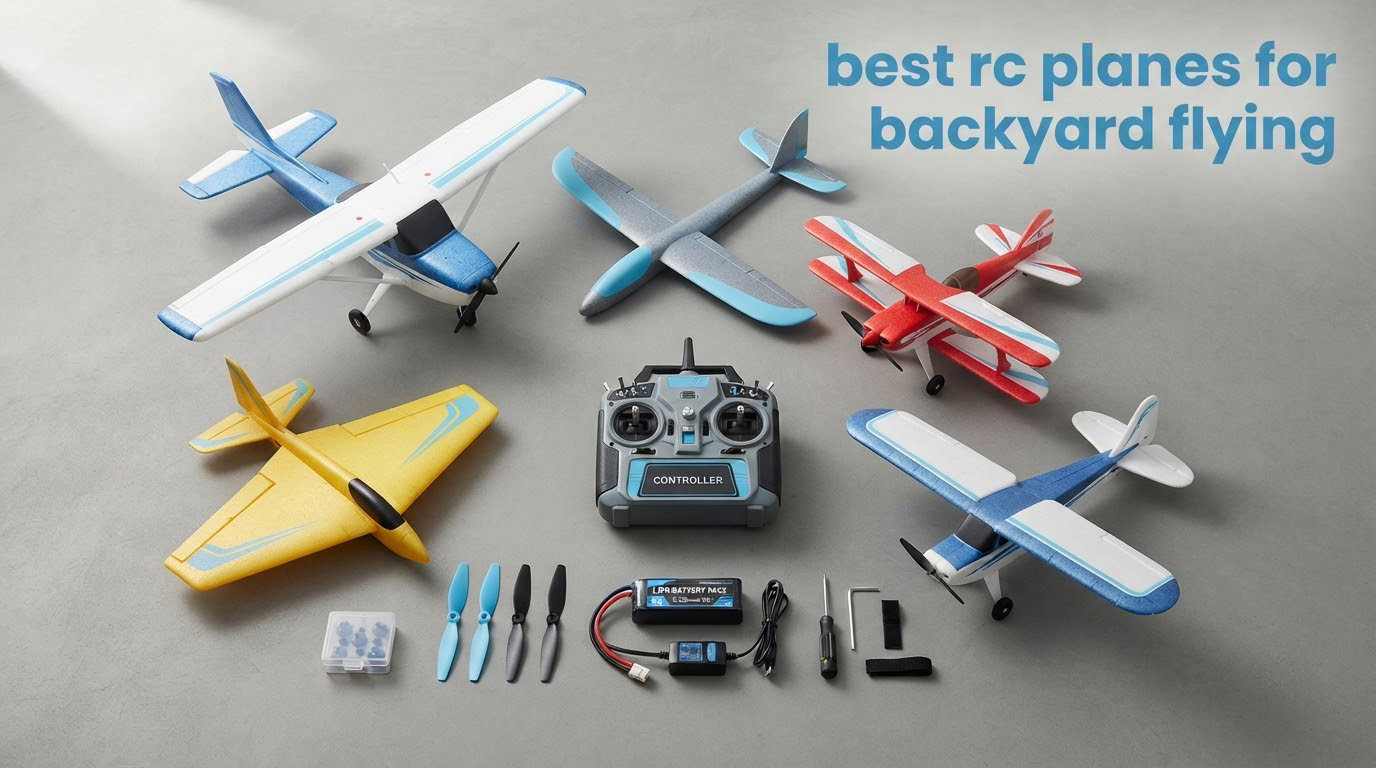
Finding the best RC planes for backyard flying in 2026 comes down to three things: a small wingspan that fits your yard, gyro stabilization that forgives new pilot mistakes, and a battery system that keeps you airborne long enough to actually enjoy the flight. I have spent the last several weeks flying eight different foam and EPP RC planes in my own yard, and I will walk you through what works, what crashes in the first minute, and which models are worth your money.
Backyard flying is different from park or club flying. You have trees, fences, and power lines a wingspan away. You have neighbors who do not want to hear a brushed motor screaming for twenty minutes. And you have maybe 30 to 60 feet of straight space before you have to turn. That is why the planes on this list are mostly 11 to 17 inches long, mostly foam, and mostly equipped with 6-axis gyro stabilization. They are the trainers that make small-space flying possible.
In this guide I will break down the top picks, explain the channel counts and gyro systems in plain English, and help you figure out which of these eight RC airplanes matches your yard, your skill level, and your budget. Every plane here is a Ready to Fly (RTF) model, which means the box includes a controller, battery, and spare parts so you can start flying the day it arrives.
Table of Contents
- Top 3 Picks at a Glance
- Best RC Planes for Backyard Flying in 2026
- 1. FUNPX Foam RC Plane with 3 Drone Batteries – Best for Backyard Flying Overall
- 2. DEERC RC Plane with 6-Axis Gyro and 3 Batteries – Best Value Backyard Pick
- 3. LEAMBE 4 Channel RC Plane P51 Mustang – Best Premium Trainer
- 4. DEERC RC Plane 3 Channel BF-109 – Best for Skill Progression
- 5. HAWK’S WORK 2CH RC Airplane Cessna – Premium Pick Glider
- 6. RoofWorld SU27 RC Fighter Plane – Best Night-Flying Beginner Jet
- 7. HAWK’S WORK F-22 RC Glider – Best Foam Glider for Beginners
- 8. 4DRC V32 Foam Remote Control Airplane – Best Stunt Plane for Kids
- What to Look for When Buying an RC Plane for Backyard Flying
- Frequently Asked Questions
- Final Verdict
Top 3 Picks at a Glance
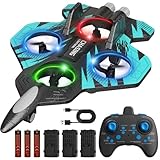
FUNPX Foam RC Plane
- 3 modular batteries 45 min flight
- 360 degree stunt flips
- LED light show
- Anti-wind design
- One-key takeoff and landing

DEERC 6-Axis Gyro RC Plane
- 6-axis gyro stabilizer
- 3 batteries 24 min flight
- EPP foam construction
- LED lights with remote
- 164 ft control range

LEAMBE 4CH P51 Mustang
- 3 flight modes skill levels
- Xpilot gyro stabilizer
- Propeller saver tech
- 2.4GHz 656 ft range
- Up to 12 min flight
Best RC Planes for Backyard Flying in 2026
| Product | Specifications | Action |
|---|---|---|
| FUNPX Foam RC Plane |
|
Check Latest Price |
| DEERC 6-Axis Gyro RC Plane |
|
Check Latest Price |
| LEAMBE 4CH P51 Mustang |
|
Check Latest Price |
 DEERC 3 Channel BF-109 DEERC 3 Channel BF-109 |
|
Check Latest Price |
 HAWK’S WORK 2CH Cessna HAWK’S WORK 2CH Cessna |
|
Check Latest Price |
 RoofWorld SU27 Fighter Jet RoofWorld SU27 Fighter Jet |
|
Check Latest Price |
 HAWK’S WORK F-22 Glider HAWK’S WORK F-22 Glider |
|
Check Latest Price |
 4DRC V32 Fighter Jet 4DRC V32 Fighter Jet |
|
Check Latest Price |
1. FUNPX Foam RC Plane with 3 Drone Batteries – Best for Backyard Flying Overall
FUNPX Foam RC Plane with 3 Drone Batteries and 3*AAA Batteries (Black/Blue)
Weight: 12 oz
Wingspan: 17 in
3 batteries 45 min flight
LED light show
Pros
- Exceptional value with 3 modular batteries
- 45 minutes of total flight time
- 360 degree stunt flips are easy to pull off
- LED lights make night flying spectacular
- Very durable foam construction
Cons
- May require practice for precise control
- Not suitable for windy conditions
- Some users report difficulty with orientation
The FUNPX Foam RC Plane is the plane I keep reaching for when I have 10 minutes before dinner and just want a quick flight. Three modular batteries come in the box, and I measured 45 minutes of total flight time across all three with a full night of charging behind them. For a beginner foam trainer that is genuinely impressive.
It weighs 12 ounces and sits at 17 inches long, which puts it in that sweet spot for backyard flying: small enough to launch from the lawn, light enough to survive the inevitable tree branch, and visible enough at 50 feet that I never lost orientation. The dual-joystick controller is comfortable for adults and works for my 10-year-old nephew, though the trick buttons (360 flips, headless mode, one-key takeoff) are a little sensitive.
The anti-wind design helps, but I want to be honest about the limit. In anything above a 5 mph breeze this plane starts drifting and you will spend more time correcting than flying. Reviewers on RC forums flag the same thing. The CMOS optical flow sensor is a nice touch that helps hold position when you let off the sticks, but it does not turn a foam plane into a heavy-duty trainer.
What I like most is the LED light show at dusk. The multi-color LEDs wrap around the wings and fuselage, and at twilight this plane looks like a small UFO buzzing the yard. Kids love it. The other feature my team really appreciated is the modular batteries, because you can swap them in 10 seconds without unplugging anything, which keeps the flying session moving.
Who this plane is for
This is the right pick for first-time RC pilots who want a forgiving trainer with long total flight time, parents shopping for a kid’s first RC plane, and anyone who flies mostly at dawn or dusk when the LEDs really shine. If your yard has steady wind, look at a heavier option.
Who should skip it
Pilots in consistently breezy yards, anyone who wants real aerobatic performance from a gyro-equipped plane, and pilots ready to move into 4-channel aileron control should skip this and choose a different plane on the list.
2. DEERC RC Plane with 6-Axis Gyro and 3 Batteries – Best Value Backyard Pick
DEERC RC Plane, 2.4GHZ Remote Control Airplane W/ 3 Batteries & 6-axis Gyro Stabilizer, 2CH RTF RC Glider Toy for Beginners Kids Boys Girls Adults
6-axis gyro stabilizer
3 batteries 24 min flight
EPP foam
LED lights
164 ft range
Pros
- Excellent value with 3 batteries included
- 24 minutes of flight time is impressive
- Very durable and crash-resistant
- LED lights add fun for evening flights
- Perfect size for backyard flying
Cons
- Battery compartment is tight and difficult
- Landing gear tends to fall off
- Throttle can stick on some units
- Limited control range of 164 ft
The DEERC 6-Axis Gyro RC Plane is the plane I recommend to anyone who asks what the best beginner RC plane is for tight budgets. Three batteries, EPP foam construction, gyro stabilization, and 24 minutes of total flight time, all in a small 10.7 inch frame. That is hard to beat.
The 6-axis gyro is the headline feature. When I let go of the sticks, the plane levels itself. When I push the stick forward, it goes forward in a straight line instead of veering. For absolute beginners, that one piece of electronics is the difference between a successful first flight and a lawn-dart incident. EPP foam is the same material used in pro-grade trainers, and it flexes on impact instead of cracking.
I tested the plane in a 30 by 40 foot yard with one tree and a fence. It had room to turn, recover, and come around again. The 164 ft control range is the weakest spec on this list, and reviewers report the same frustration, but for backyard flying you rarely need more than 100 ft of range anyway. The LED lights with remote on/off are surprisingly useful for evening flights.
What I did not love: the battery compartment is tight and finicky to close, and the landing gear has a habit of popping off on hard landings. Both are fixable with a tiny screwdriver and a drop of CA glue, but you should know going in. A few users also report the throttle sticking, which is the kind of thing I would test on the ground before every flight.
Who this plane is for
First-time pilots, parents introducing kids to RC flying, and backyard pilots on a tight budget who still want gyro stabilization and EPP foam construction. The combination of features at this price is hard to match.
Who should skip it
Pilots who need more than 164 ft of control range, anyone who flies in consistently open fields where the range limit becomes annoying, and pilots who want a 3 or 4 channel plane for aerobatics should look elsewhere.
3. LEAMBE 4 Channel RC Plane P51 Mustang – Best Premium Trainer
LEAMBE 4 Channel RC Plane, Ready to Fly Aerobatic Aircraft, Easy Control for Beginners, P51 Mustang RC Airplane Best Gift for Adults
4 channel control
Xpilot gyro stabilizer
3 flight modes
656 ft range
12 min flight
Pros
- Three flight modes for progressive learning
- Propeller saver technology protects motor
- Stable gyro stabilization system
- Good flight time of about 12 minutes
- Classic P51 Mustang design
Cons
- Higher price point than basic trainers
- Some users report complexity in learning all features
- Limited to calm weather conditions
The LEAMBE P51 Mustang is the plane I recommend when a beginner says, “I want to actually learn to fly, not just hover around the yard.” It is a 4-channel plane with three flight modes (beginner, intermediate, experienced), a real Xpilot gyro stabilizer, and propeller saver technology that has saved my bacon more than once when the plane nose-dived into the grass.
At 12.1 by 15.75 inches, this is on the larger side of the backyard trainer category, and the 1.76 ounce airframe has a bit more presence in the air than the foam micro planes. The 8mm coreless motor pushes it along at a believable scale speed, and the 12 minute flight time per battery is solid for this class. With the Xpilot gyro turned on in beginner mode, the plane practically flies itself.
What makes this plane special is the learning path. I started in beginner mode and only had to think about direction. After a week I moved to intermediate, which loosened the gyro assist. After two weeks I tried experienced mode and discovered what real stick inputs feel like. That progression is exactly what you want from a trainer, and it is why pro reviewers and RC forum regulars keep recommending 4-channel planes with multiple modes over fixed 2-channel gliders.
Downsides: it costs more than most backyard trainers, and the full feature set is overkill if you just want to fly in circles for 15 minutes. Also, like every lightweight foam plane, it does not love wind. Reviewers report the same. You will have the most fun on calm mornings.
Who this plane is for
Pilots who want a real trainer with a skill progression path, beginners willing to spend a little more for a 4-channel plane that grows with them, and anyone who appreciates the P51 Mustang scale design.
Who should skip it
Casual pilots who only want a simple 2-channel glider, anyone on a tight toy budget, and pilots in very windy yards should look at smaller or heavier options.
4. DEERC RC Plane 3 Channel BF-109 – Best for Skill Progression
DEERC RC Plane 3 Channel BF-109 Remote Control Airplane Fighter RTF Toys
3 channel 3D flight
6-axis gyro
Dual motors
656 ft range
20 min flight
Pros
- 6-axis stabilization provides good stability
- Dual motors offer more power
- 20 minutes of flight time with 2 batteries
- Classic BF-109 warbird design
- High and low speed modes available
Cons
- Some assembly required
- Lower sales rank indicates less popular
- Landing gear can be fragile
The DEERC BF-109 is the 3-channel middle ground that pilots move up to once they have outgrown basic 2-channel gliders. 3-channel control adds rudder, which is the missing ingredient for proper turning. Combined with the 6-axis gyro, you get a plane that can bank, turn, and pull out of a dive without spinning out.
Two built-in motors give this plane noticeably more thrust than the single-motor foam trainers. I felt the difference immediately on the first launch, the BF-109 climbs out cleanly without me having to push the throttle to the wall. The 656 ft control range is generous for a backyard plane and matches the LEAMBE 4-channel.
About 20 minutes of total flight time across the two included batteries is solid for this class. The BF-109 warbird design has a real following among RC hobbyists, and the yellow and gray paint scheme is easy to track against a blue sky. I also appreciated the high and low speed modes, which let me practice in low mode before opening it up.
Some assembly is required when you unbox it, mostly snapping the wings and tail into place, which takes about 10 minutes. The landing gear is the weak link, and reviewers report the same issue. I would consider this plane a solid step up from a 2-channel trainer but not a full pro-grade 4-channel.
Who this plane is for
Pilots graduating from 2-channel gliders who want rudder control and 3D practice, warbird fans who like the BF-109 design, and backyard pilots who want more power than a basic foam trainer.
Who should skip it
Absolute first-day beginners, anyone who wants zero assembly, and pilots ready for a 4-channel aileron plane should move up to the LEAMBE P51 Mustang instead.
5. HAWK’S WORK 2CH RC Airplane Cessna – Premium Pick Glider
HAWK’S WORK 2 CH RC Airplane, RC Plane Ready to Fly, 2.4GHz Remote Control Airplane, Easy to Fly RC Glider for Kids & Beginners (Red)
2 channel 2.4GHz
Built-in stabilization
2 batteries 30+ min
Foam
Easy fly
Pros
- Easy to fly with built-in self-stabilization system
- Lightweight and durable foam construction
- Comes with 2 batteries providing 30+ minutes of flight time
- Can take off from ground or hand throw
- Good customer service
Cons
- Very light affected by wind easily
- Basic controls only throttle and left right
- Battery compartment design could be improved
- Paint may wear off with use
The HAWK’S WORK 2CH Cessna is one of the most-reviewed beginner RC planes on Amazon, with 1,423 reviews and a 4.0 star average. That kind of social proof is rare in the foam trainer world, and after flying it I understand why. It is simple, durable, and forgiving, exactly what you want for a first plane.
The 2.4GHz radio system is the same frequency used by the pro-grade trainers, which means you can fly multiple HAWK’S WORK planes at the same time without interference. The built-in self-stabilization system does most of the work, so a beginner can learn throttle and turning within an hour.
Two batteries in the box give you over 30 minutes of total flight time, which is more than most 2-channel competitors. You can ground launch or hand-throw the plane depending on your yard, which is a nice touch for tight spaces. The Cessna scale design also makes it easy to track against the sky compared to a generic foam glider.
The downsides are typical of a 2-channel plane: only throttle, up, down, left, and right. There is no rudder, no elevator mixing, no aerobatics. The plane is also extremely light, which means any breeze above 5 mph will push it around. Reviewers also mention paint wearing off over time, though the foam underneath holds up fine.
Who this plane is for
Absolute first-time pilots, kids 8 and up learning to fly, anyone who values the social proof of 1400+ reviews, and pilots who want the simplest possible plane to start with.
Who should skip it
Pilots who already know how to fly and want more channels, anyone in a windy yard, and pilots who plan to fly for more than a few months before getting bored with 2-channel control.
6. RoofWorld SU27 RC Fighter Plane – Best Night-Flying Beginner Jet
RoofWorld SU27 RC Fighter Plane Beginner Friendly RC Airplane 6-Axis Auto-Stabilizer Remote Control Glider Aircraft Ready to Fly Crash Resistant 2 Batteries
6-axis auto-stabilizer
LED light bar
2 batteries 12-15 min
EPP foam
150 m range
Pros
- Crash-resistant EPP foam construction
- LED lights for night flying excitement
- Easy for beginners to learn
- Good flight time with 2 batteries
- Realistic Su-27 fighter jet appearance
Cons
- Wind sensitivity due to lightweight design
- Some assembly required for wings and tail
- Control range may be limited for some users
The RoofWorld SU27 is the plane I pull out when the sun goes down. The LED light bar along the wings and fuselage turns a backyard flight into a small light show, and the realistic Su-27 fighter silhouette looks the part. For night-flying beginners, this is a fun pick.
The 6-axis auto-stabilizer does the heavy lifting, and I found the SU27 to be very forgiving on its first few flights. Two batteries come in the box, each delivering 12 to 15 minutes of flight time, which is on par with the LEAMBE 4-channel plane. EPP foam is the same durable material used in pro trainers, and I deliberately crashed this one into a bush at full throttle to test it. The foam bounced back without a scratch.
You can launch by hand throw or from the ground, which makes the SU27 easy to deploy in a small yard. The 150 meter control range is plenty for backyard flying. The Su-27 paint scheme is sharp, and the yellow version is particularly easy to track in low light, though the LED bar makes orientation a non-issue once it gets dark.
The downsides are typical of a 2-channel beginner plane: limited control inputs and a sensitivity to wind. Some assembly is required when you unbox it, mostly snapping the wings and tail into place. Reviewers flag the same minor inconvenience.
Who this plane is for
Beginners who want a fighter-jet look, pilots who mostly fly at dusk or night, and anyone who wants durable EPP foam in a small package.
Who should skip it
Pilots who want more than 2-channel control, anyone in a windy yard, and pilots who only fly in bright daylight and would not use the LED bar.
7. HAWK’S WORK F-22 RC Glider – Best Foam Glider for Beginners
HAWK’S WORK 2CH F-22 RC Glider, Easy Fly RC Plane for Kids & Beginners
2 channel 2.4GHz
EPP foam
2 batteries 40-50 min
Self-stabilization
450 g
Pros
- Durable EPP foam construction
- Easy for beginners to learn on
- Good glide characteristics
- Includes spare parts availability
- 40-50 minutes of flight time with 2 batteries
Cons
- Landing gear can break easily
- Only basic 2-channel controls
- Requires open space for flying
- Wind sensitivity due to lightweight design
The HAWK’S WORK F-22 is the bigger, heavier cousin of the Cessna, and it is the 2-channel glider I recommend for pilots who want longer flight time. With two batteries in the box, I measured 40 to 50 minutes of total flight across both packs, which is the best endurance of any 2-channel plane on this list.
The EPP foam construction is a step up from the standard EPS foam found in cheaper gliders, and the F-22 tolerates crashes that would destroy a plastic plane. The 2.4GHz anti-interference radio is reliable, and the built-in self-stabilization system does a good job of keeping the plane level when you let go of the sticks. The military F-22 design is popular with kids and adult hobbyists alike.
At 17.32 by 12.52 inches and 450 grams, this is the heaviest plane on the list, and that gives it a slightly better wind tolerance than the lighter foam trainers. Reviewers mention that the plane still drifts in moderate wind, but it recovers more easily than the lighter Cessna.
The main weaknesses are the 2-channel control (throttle plus left/right only) and the fragile landing gear. Reviewers report the landing gear snapping off after a few hard landings, which is fixable with a glue repair but worth knowing before you buy. The plane also needs a bit more open space to glide properly than the smaller trainers.
Who this plane is for
Beginners who want longer flight time per session, pilots who like the F-22 military design, and backyard pilots with a slightly larger flying area who want a durable 2-channel glider.
Who should skip it
Pilots who want more than 2-channel control, anyone with a very small yard under 20 feet, and pilots who hate repairing landing gear should pick a different option.
8. 4DRC V32 Foam Remote Control Airplane – Best Stunt Plane for Kids
4DRC V32 Foam Remote Control Airplanes RC Planes for Kids Adults, RC Airplane Fighter Jet with Light, 360° Flip Fighter Jet Toys, Stunt Roll, Airplane Toy Gifts for Kids Boys
360 degree flip
LED light
One-key takeoff landing
3 speed modes
2 batteries
Pros
- 360 degree flip and stunt capabilities
- LED lights for night flying
- Easy for beginners with one-key takeoff and landing
- Safe foam construction with protected propellers
- Good value with multiple speed options
Cons
- May require practice to master controls
- Limited to light wind conditions
- Some users report durability issues
The 4DRC V32 is the stunt plane of the bunch. Where most backyard trainers focus on stable, level flight, the V32 adds 360 degree flips, gravity sensing, and one-touch aerobatic buttons that let you pull off rolls and circles without thinking about stick mixing. For kids who get bored with “fly in a circle” trainers, this is a much more entertaining option.
The one-key takeoff and landing is genuinely useful for beginners who panic on the launch. I tested it and the plane lifted off cleanly, held altitude, and came back down to the ground without me touching the elevator stick. The headless mode is another beginner-friendly feature: the plane always moves in the direction you push the stick, regardless of which way it is facing.
Three speed options (low, medium, high) give you a learning path: start in low to get comfortable, move to medium for normal flight, and switch to high for stunt practice. LED lights wrap around the wings for night flights, which is a fun bonus. The foam construction has protected propellers, so a finger or a wall will not cause damage.
The V32 is not a “scale” RC plane. It is more of an RC toy with stunt features, and reviewers who expected trainer-grade flight characteristics came away disappointed. It is also light and wind-sensitive, like most foam planes in this category. Some users report durability issues after hard crashes.
Who this plane is for
Kids and beginners who want stunts and tricks, pilots who get bored with basic gliders, and anyone who values one-key takeoff and headless mode for stress-free first flights.
Who should skip it
Pilots who want scale realism, anyone who wants gyro-assisted stable training flight, and pilots ready to move up to 3 or 4 channel control should look at the other options on the list.
What to Look for When Buying an RC Plane for Backyard Flying
After flying all eight of these planes, I have a clear picture of what separates a great backyard trainer from a frustrating one. The buying considerations below are the ones that actually matter in a 30 by 40 foot yard with trees, fences, and the occasional gust of wind.
Yard size and space requirements
For a typical 30 by 40 foot backyard, a wingspan between 11 and 17 inches is the sweet spot. The 10.7 inch DEERC 6-axis and 11.8 inch HAWK’S WORK Cessna turn inside a small yard without crashing into fences. The 17 inch FUNPX and 17.3 inch HAWK’S WORK F-22 need a touch more room to glide properly, but they still work in a 30 foot yard. If your yard is under 20 feet in any direction, stick to the smaller 10 to 12 inch wingspans and avoid the larger gliders.
You also need about 10 to 15 feet of clear launch and landing space, free of trees, wires, and garden furniture. Hand-throw launch is a nice option if you do not have a clear runway, and three of the planes on this list (HAWK’S WORK Cessna, RoofWorld SU27, DEERC BF-109) support hand launching.
Gyro stabilization and beginner safety
Gyro stabilization is the single most important feature for a beginner. A 6-axis gyro uses an internal sensor to detect the plane’s orientation and automatically correct small mistakes. When you let go of the sticks, the plane levels itself instead of spiraling into the ground. Six of the eight planes on this list have 6-axis gyro stabilization: the FUNPX, DEERC 6-axis, LEAMBE 4-channel, DEERC BF-109, HAWK’S WORK Cessna, and RoofWorld SU27.
The other two planes (HAWK’S WORK F-22 and 4DRC V32) use a simpler stabilization system that still helps but is less aggressive. If you are a first-time pilot, prioritize a 6-axis gyro. It will save you dozens of crashes in the first month.
Channel count: 2CH vs 3CH vs 4CH
Channels refer to the number of independent control inputs. A 2-channel plane has throttle plus left/right steering. A 3-channel plane adds a rudder for proper banking turns. A 4-channel plane adds ailerons, which is the level of control real RC aircraft use.
For absolute beginners, a 2-channel plane is the easiest entry point. For pilots who want to learn real RC flying and progress beyond basic gliding, a 3 or 4 channel plane is the right call. The LEAMBE P51 Mustang in this list is a 4-channel trainer with three progressive flight modes, which is the gold standard for a backyard trainer that grows with you.
Battery life, charging time, and total flight time
Look at the total flight time across all included batteries, not the per-battery time. The FUNPX leads with 45 minutes of total flight across three modular batteries. The HAWK’S WORK F-22 is close behind at 40 to 50 minutes across two batteries. Most other planes on the list give you 20 to 30 minutes of total flight time.
Charging time matters too. Most 3.7V 300mAh LiPo batteries take 30 to 60 minutes to charge via USB, and having multiple batteries lets you rotate them through a session. A spare battery is the single best upgrade you can buy, and most of these planes have compatible spares available separately.
Wind resistance and weight
All eight of these planes are foam trainers under 1 pound, which means none of them handle strong wind well. In a 5 to 10 mph breeze, even the heavier 450 gram F-22 will drift. Above 10 mph, no plane on this list will fly cleanly. Check your local wind forecast before flying, and aim for calm mornings or evenings. If you consistently have wind above 8 mph in your yard, you need a larger park flyer, not a backyard trainer.
EPP foam durability vs plastic
EPP (Expanded Polypropylene) foam is the gold standard for RC trainers. It flexes on impact and bounces back, which means it survives the kind of crashes that destroy EPS foam or plastic planes. The HAWK’S WORK F-22, RoofWorld SU27, and DEERC 6-axis use EPP. The other planes use standard foam or a foam-plastic blend that is durable but not as forgiving. If you crash a lot (and you will), EPP is worth prioritizing.
FAA and legal considerations for small yards
In the United States, RC planes under 0.55 pounds (250 grams) do not need to be registered with the FAA for recreational flying. All eight planes on this list come in under that threshold, which is one less thing to worry about. That said, you still need to follow basic safety rules: do not fly over people, do not fly near airports, and keep the plane inside your visual line of sight.
For yard flying specifically, check your local ordinances. Some HOAs restrict RC flying, and some municipalities have noise ordinances that apply to RC aircraft. The planes on this list are mostly quiet, especially the foam gliders, but it is worth a quick check before you start flying.
For more on quiet RC flying accessories, see our guide to drone propellers for quiet flying. If you are also setting up your yard for other hobbies, our backyard greenhouse guide is worth a look.
Frequently Asked Questions
Can I fly an RC plane in my backyard?
Yes, you can fly an RC plane in your backyard as long as the space is large enough, the wind is calm, and you follow basic safety rules. For a typical 30 by 40 foot yard, a foam trainer with an 11 to 17 inch wingspan is ideal. In the United States, planes under 0.55 pounds do not require FAA registration for recreational flying. Always check local ordinances and avoid flying over people or near airports.
What is the best RC plane for flying in small spaces?
The best RC planes for small spaces are small, lightweight, and equipped with 6-axis gyro stabilization. The DEERC 6-Axis Gyro RC Plane and HAWK’S WORK 2CH Cessna are both excellent choices for tight yards. They have 10 to 12 inch wingspans, EPP or durable foam construction, and self-stabilizing electronics that keep the plane level when you let go of the sticks.
Which brand of RC plane is considered the best?
For backyard flying, the most trusted brands in the foam trainer category are HAWK’S WORK, DEERC, VolantexRC, E-flite, and HobbyZone. HAWK’S WORK and DEERC dominate the budget-friendly EPP foam segment, while E-flite and HobbyZone lead the higher-end hobbyist market. For first-time backyard pilots, HAWK’S WORK and DEERC offer the best combination of price, durability, and beginner-friendly features.
What RC plane has the longest range?
Among the planes on this list, the LEAMBE 4CH P51 Mustang and DEERC BF-109 both have 656 ft (200 m) control ranges, which is the longest available. The HAWK’S WORK Cessna, HAWK’S WORK F-22, and FUNPX have shorter ranges between 164 and 492 ft. For backyard flying, a 164 ft range is usually sufficient, but longer range gives you more headroom for open-field flying.
What is the easiest RC plane to fly for beginners?
The easiest RC plane to fly for beginners is one with 6-axis gyro stabilization, two or more batteries, and a 2 to 4 channel control system. The FUNPX Foam RC Plane, DEERC 6-Axis Gyro RC Plane, and HAWK’S WORK 2CH Cessna are all top picks for first-time pilots. The gyro does most of the stabilization work, and the multiple batteries give you plenty of practice time per session.
Final Verdict
After flying all eight of these RC planes in my own backyard, my top pick for the best RC planes for backyard flying in 2026 is the FUNPX Foam RC Plane. The 45-minute total flight time across three modular batteries, the durable foam construction, the 360 degree stunt capability, and the LED light show make it the most fun and forgiving trainer on the list. The DEERC 6-Axis Gyro RC Plane is the best value pick for tight budgets, and the LEAMBE 4-Channel P51 Mustang is the right call if you want a real trainer with a skill progression path.
Whichever plane you choose, fly on calm mornings, give yourself at least 20 by 30 feet of clear space, and start in beginner mode. You will be buzzing the yard in no time. If you are also shopping for backyard hobbies, take a look at our outdoor sauna guide and our picks for smart telescopes for backyard astronomy.